

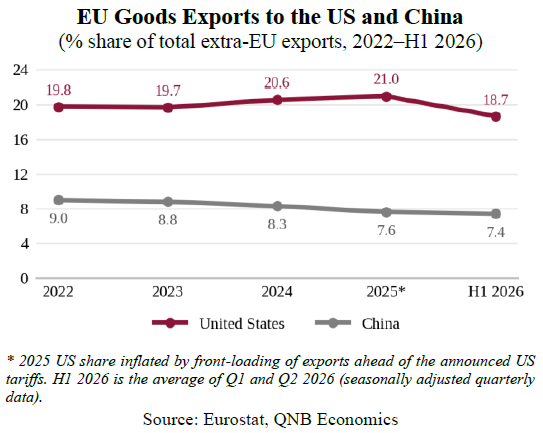
Over the past two years, the external environment of the European Union (EU) has deteriorated markedly, as its two largest trading partners have become less reliable at the same time. In the US, the new EU-U.S. Framework on Reciprocal, Fair, and Balanced Trade is a major bilateral trade framework between the United States and the European Union and entered into force on July 1, 2026. This deal sets a 15% tariff ceiling on most EU exports, a structurally higher barrier for Europe’s largest export market. China, meanwhile, has shifted from a key source of demand to an intensifying competitor: the EU’s goods trade deficit with China reached EUR 359.8 Bn in 2025, as EU exports fell by 6.5% while imports rose by 6.4%. In response, Brussels has embarked on the most ambitious expansion of its trade network in decades. In 2025 and the first half of 2026, the EU concluded trade agreements with Mercosur, Mexico, Indonesia, India and Australia, which together will increase the share of the EU’s external trade covered by free trade agreements (the share of the EU’s trade with non-EU countries that takes place with partners covered by a free trade agreement) to 53.3%, up from 46.3% at the end of 2025. The pivot is now extending deeper into Southeast Asia. The EU and the Philippines reached substantial agreement on a free trade deal in September, liberalising more than 94% of tariff lines, while talks with Thailand and Malaysia are advancing, with all three agreements collectively targeted for completion by 2027. Together with existing agreements with Singapore, Vietnam and Indonesia, this would give the EU a near region-wide network across ASEAN, one of the world’s fastest-growing regions.
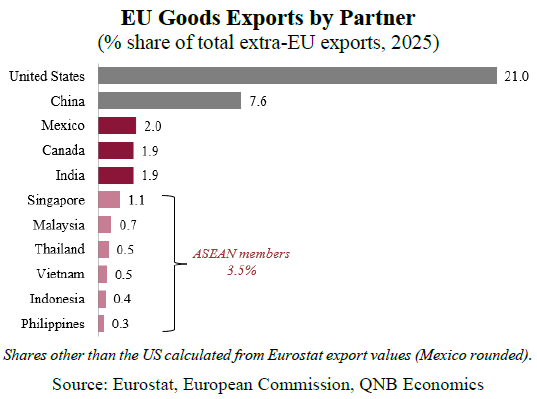
In our view, the EU’s trade pivot is a strategic response to a lasting shift in the global trading environment, and its benefits will build gradually as the new agreements enter into force. In this article, we discuss three key objectives behind Europe’s trade pivot: diversification away from its main trading partners, whose policies have become increasingly unpredictable, new sources of external demand and growth opportunities for a subdued European economy, as well as economic security through more reliable access to critical raw materials.
First, the new agreements reduce the EU’s exposure to its two largest trading partners, which have increasingly become unpredictable. Higher US tariffs have weighed on demand as EU exports to the US fell by 30.4% year-on-year in the first quarter of 2026. This decline is however amplified by high export levels in early 2025, due to potential front-loading ahead of the announced US tariffs. At the same time, China is redirecting exports lost in the US market towards Europe: its trade surplus with the EU grew by 24% in the first four months of 2026. Therefore, concluding a broader network of new trade agreements can act as an insurance mechanism by diversifying external demand across more partners and reducing vulnerability to policy shocks or concentration risks in any single market. The evidence suggests this is already working. In 2025, trade covered by free trade agreements grew by 3.1%, more than double the 1.4% growth with other third countries, with exports to free trade partners rising by EUR 250 Bn. To give a comparison: this more than offsets the EUR 54.5 Bn loss of exports to Russia.
Second, the new agreements open up sources of external demand at a time when growth in Europe remains subdued and its industrial core is under pressure as the manufacturing sector is still underperforming. The India agreement shows the potential. Tariffs of up to 44% on machinery and 22% on chemicals will be largely eliminated, while duties on European cars will gradually fall from 110% to 10% within an annual quota of 250,000 units. These are precisely the sectors where European, and particularly German, manufacturers are losing ground to Chinese competition. Overall, the agreement aims to double EU goods exports to India by 2032, saving around EUR 4 Bn a year in duties. However, the gains will build gradually, as implementation of the India agreement is expected from January 2027 and tariff cuts are phased in over several years. The Mercosur agreement, provisionally applied since May 2026, shows that benefits can start earlier: it immediately removed or drastically reduced tariffs on key EU exports such as cars and pharmaceuticals, and is expected to boost EU annual exports to the region by 39% by 2040. Early signs suggest trade flows respond quickly, as Argentina’s agro-industrial exports to the EU rose by 21% in the first four months of application, compared with the average of the previous three years.
Third, trade agreements have become a central instrument of Europe’s economic security, particularly for critical raw materials. The EU remains highly exposed to China, from which it sources all of its heavy rare earths and 98% of its rare-earth magnets, inputs that are essential for the automotive, renewable energy and defence industries. This vulnerability is pressing, as China’s suspension of its second wave of export controls expires on 10 November 2026. Agreements with resource-rich partners offer alternative channels of supply. Preferential partners already supply a quarter of the EU’s critical raw material imports, and imports from Canada rose by 62% in 2025. The new agreement with Indonesia for example will broaden these sources further, strengthening access to its vast reserves of nickel, cobalt, copper, and tin. Diversification will not remove dependence on China, which controls 90% of global rare earth refining, but it reduces Europe’s exposure and concentration risks.
All in all, Europe’s trade pivot is a strategic response to a more fragmented and less predictable global economy. The new agreements diversify external demand away from its two largest trading partners, open growth opportunities in dynamic markets such as India, Mercosur and ASEAN, and secure more reliable access to critical raw materials. While the gains will build gradually, they should strengthen the resilience of the European economy over the medium term.
Download the PDF version of this weekly commentary in English or عربي